
Introduction
AI notes are faster, traditional notes are deeper—and knowing when to use each can decide how well you remember, decide, and act. As AI note-taking tools become mainstream, many people assume automation is always better than writing by hand or typing manually. In reality, both approaches excel in different situations. This article compares AI notes and traditional notes using real-world scenarios: studying, meetings, planning, and long-term projects. You’ll learn where AI genuinely saves time, where manual notes protect understanding, and how a hybrid approach often delivers the best results.
What AI notes are genuinely good at
AI notes shine in situations where volume and speed matter more than deep thinking.
Key strengths of AI notes
- Rapid capture: Long meetings, lectures, or brainstorming sessions
- Instant structure: Headings, bullet points, and summaries
- Searchability: Finding ideas weeks later without scanning pages
- Low effort: Reduced friction when energy is low
From practical usage, AI notes are especially helpful for record-keeping and information management, not judgment.
Where traditional notes still outperform AI
Traditional notes—handwritten or manually typed—excel when understanding and memory are the goal.
Key strengths of traditional notes
- Active processing: Writing forces you to think and rephrase
- Better recall: Manual effort strengthens memory formation
- Nuance preservation: You decide what matters, not an algorithm
- Personal meaning: Symbols, emphasis, and spacing reflect intent
For learning, decisions, and complex reasoning, traditional notes remain hard to beat.
Common mistakes people make when choosing between AI and manual notes
Mistake 1: Using AI notes for everything
Fix: Reserve AI for capture and organization; use manual notes for learning and decisions.
Mistake 2: Assuming faster notes mean better notes
Fix: Measure success by recall and clarity, not speed.
Mistake 3: Abandoning manual notes entirely
Fix: Keep at least one manual step in critical workflows.
Information Gain — why speed often reduces understanding
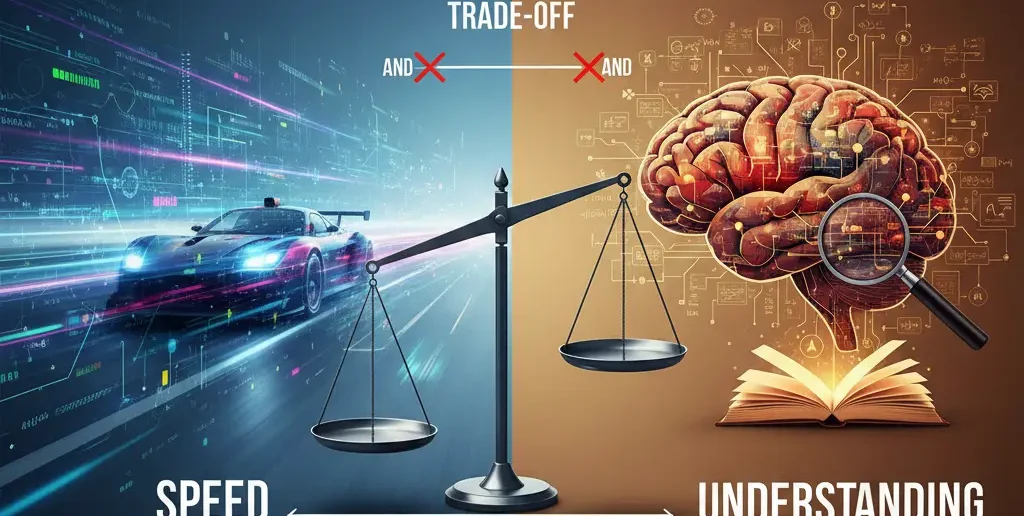
Most SERP comparisons focus on convenience. What they miss: speed can weaken comprehension. When AI summarizes instantly, your brain skips the effort needed to encode information. Counter-intuitive insight: slower note-taking often leads to faster problem-solving later, because you remember more and revisit notes less often.
Real-world scenario: the same content, two note methods
Consider a 60-minute lecture:
| Aspect | AI Notes | Traditional Notes |
| Capture | Complete transcript | Selective points |
| Structure | Auto-generated | Manually organized |
| Understanding | Medium | High |
| Exam recall | Moderate | Strong |
| Review speed | Fast | Medium |
Students who combined both—AI capture plus manual rewrite—performed best.
When AI notes clearly help
Use AI notes when:
- You need records, not insights
- Meetings generate lots of information
- You revisit notes infrequently
- Search speed matters more than memory
AI acts as an external memory.
When traditional notes are the safer choice
Stick to manual notes when:
- Preparing for exams
- Making strategic decisions
- Learning new or abstract concepts
- Accuracy and nuance are critical
Here, thinking matters more than speed.

A hybrid note-taking system that actually works
The most reliable approach blends both methods:
| Stage | Best Method | Why |
| Capture | AI notes | Speed & completeness |
| First review | Manual notes | Understanding |
| Organization | AI assistance | Structure |
| Final decisions | Manual summary | Accountability |
This system preserves learning while saving time.
[Expert Warning]
Relying only on AI notes for learning can create false confidence—notes look clean, but understanding may be shallow.
[Pro-Tip]
Rewrite AI-generated summaries in your own words once. This single step dramatically improves retention.
[Money-Saving Recommendation]
You don’t need premium AI tools if manual notes handle learning and AI handles capture. Balance reduces costs.
(Natural transition) When choosing an AI note-taking app, look for tools that support hybrid workflows instead of forcing full automation.
How to decide which method to use (quick checklist)
Ask yourself:
- Do I need to remember this long-term?
- Will I be tested or judged on accuracy?
- Is speed more important than understanding?
If memory and accuracy matter, lean manual. If volume and retrieval matter, lean AI.
FAQs
Are AI notes better than handwritten notes?
Not for learning. AI is faster; handwriting improves memory.
Can AI notes replace traditional notes?
No. They work best together.
Which is better for exams?
Traditional notes or hybrid workflows outperform pure AI notes.
Are AI notes accurate enough for decisions?
They require human review to avoid context loss.
What’s the best way to combine both?
AI for capture, manual notes for understanding and final summaries.
internal link:
Embedded YouTube (contextual)
- Handwriting & memory: https://www.youtube.com/watch?v=85n4mWv7y0M
- Digital vs manual notes: https://www.youtube.com/watch?v=1cZp7v6xkqY
External link:
Conclusion
AI notes and traditional notes are not rivals—they’re tools for different jobs. Automation excels at capture and organization; manual notes protect understanding and judgment. When you choose intentionally—or combine both—you get speed without sacrificing clarity. That balance is where AI note-taking truly adds value.