Introduction — why this matters now
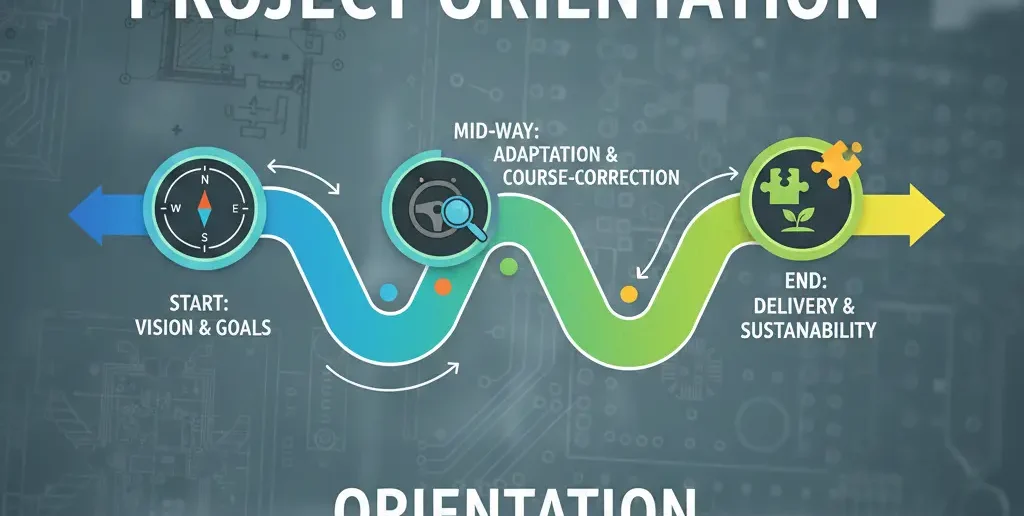
AI notes projects fail most often not at the start, but halfway through. While AI tools capture information quickly, long-term projects require structure, context, and regular review to stay oriented over time.
Early on, everything feels clear: goals are fresh, tasks are obvious, and summaries look perfect. Months later, context fades. Decisions lose their “why,” priorities drift, and reopening notes feels like starting over. This article shows how to use AI notes to stay oriented over time—so projects remain understandable, actionable, and resilient as people, timelines, and scope change.
AI Notes Projects: Staying Oriented in Long-Term Work
Long projects stress note systems in ways daily planning doesn’t.
Common stressors include:
Changing goals and constraints
New stakeholders joining midstream
Decisions made weeks apart
Notes created by different people
AI can organize text—but orientation requires preserved context.
What orientation really means in a long-term AI notes projects
Orientation is your ability to answer, quickly:
What is this project trying to achieve now?
Why were past decisions made?
What assumptions are still valid?
What’s next, and what’s blocked?
If your notes don’t answer these, they’re archival—not operational.
Where AI genuinely helps long-term AI notes projects
Used deliberately, AI adds leverage in three places.
1) Capturing continuity
AI is excellent at:
Summarizing progress across weeks
Pulling threads from scattered updates
Creating periodic “state of the project” snapshots
This reduces the cost of re-entry after time away.
2) Consolidating scattered history
AI can merge:
Meeting notes
Decision logs
Task updates
into a single navigable overview—if humans approve the structure.
3) Fast reorientation
Semantic search helps you find:
When a decision was made
Who agreed
What constraints existed
This prevents re-litigating old ground.
Where AI causes long-term drift AI notes projects
Problems arise when AI output replaces human checkpoints.
Summary overwrite
Repeated summarization smooths out nuance and erases decision rationale.
Timeline flattening
AI clusters content by topic, not by time—hiding sequence and cause-and-effect.
Ownership erosion
As notes accumulate, responsibility becomes ambiguous unless explicitly recorded.
Common long-project mistakes (and fixes)
Mistake 1: Treating summaries as permanent truth
Fix: Version summaries by date; never overwrite without review.
Mistake 2: No single “project north star”
Fix: Maintain one human-written project brief that AI references—but never edits.
Mistake 3: Letting notes grow without pruning
Fix: Archive aggressively; keep only what informs future action.
Information Gain — why long-term clarity depends on time, not tags
Most SERP advice emphasizes tagging and linking. What’s often missing is temporal orientation. Counter-intuitive insight: projects stay clear when notes are organized by time checkpoints, not by topic alone. Weekly or milestone-based summaries preserve cause-and-effect that topical clustering loses.
Practical insight from experience: the “decision spine”
High-performing teams maintain a decision spine—a running log of:
Decision
Date
Rationale
Owner
Review trigger
AI can draft this from notes, but humans must confirm entries. When scope shifts, this spine keeps projects grounded.
A resilient AI note structure for long-term projects
Use this structure to preserve orientation:
| Layer | Purpose | AI Role |
| Project brief | North star | None |
| Decision log | Preserve rationale | Draft entries |
| Progress notes | Weekly snapshots | Summarize |
| Action tracker | What’s next | Minimal |
| Archive | Reduce noise | Optional |
AI supports consolidation—not direction.
[Expert Warning]
If reopening a project requires rereading weeks of notes, orientation has already failed.
[Pro-Tip]
Add a “Still true?” line to major assumptions. Review it at milestones to prevent drift.
[Money-Saving Recommendation]
Advanced AI features don’t fix long-term confusion. Clear briefs and decision logs do.
(Natural transition) When choosing AI note-taking tools for long projects, prioritize versioning, exportability, and visible timelines over flashy dashboards.
How to reorient a long-term project in 30 minutes
Read the project brief
Scan the last two milestone summaries
Review the decision spine
Identify invalid assumptions
Define the next concrete action
This resets clarity faster than reorganizing notes.
FAQs
Can AI manage long-term projects on its own?
No. It can assist with summaries and retrieval, but humans must set direction.
Why do long projects lose clarity over time?
Context fades as decisions and assumptions aren’t preserved explicitly.
How often should project notes be summarized?
At milestones or weekly—never continuously without review.
What’s the most important long-term note?
A human-written project brief that evolves intentionally.
Do tags help long-term orientation?
Only minimally. Time-based checkpoints matter more.
internal link
Embedded YouTube
Managing long-term projects: https://www.youtube.com/watch?v=ZfZ7c1E0YpA
Keeping projects on track: https://www.youtube.com/watch?v=K-ssUVyfn5g
External link :
Conclusion
AI notes can keep long-term projects coherent—but only when orientation is designed, not assumed. Anchor work in a clear project brief, preserve decisions over time, and use AI to summarize checkpoints, not rewrite history. When time is respected as structure, projects stay understandable—even months later.