Introduction
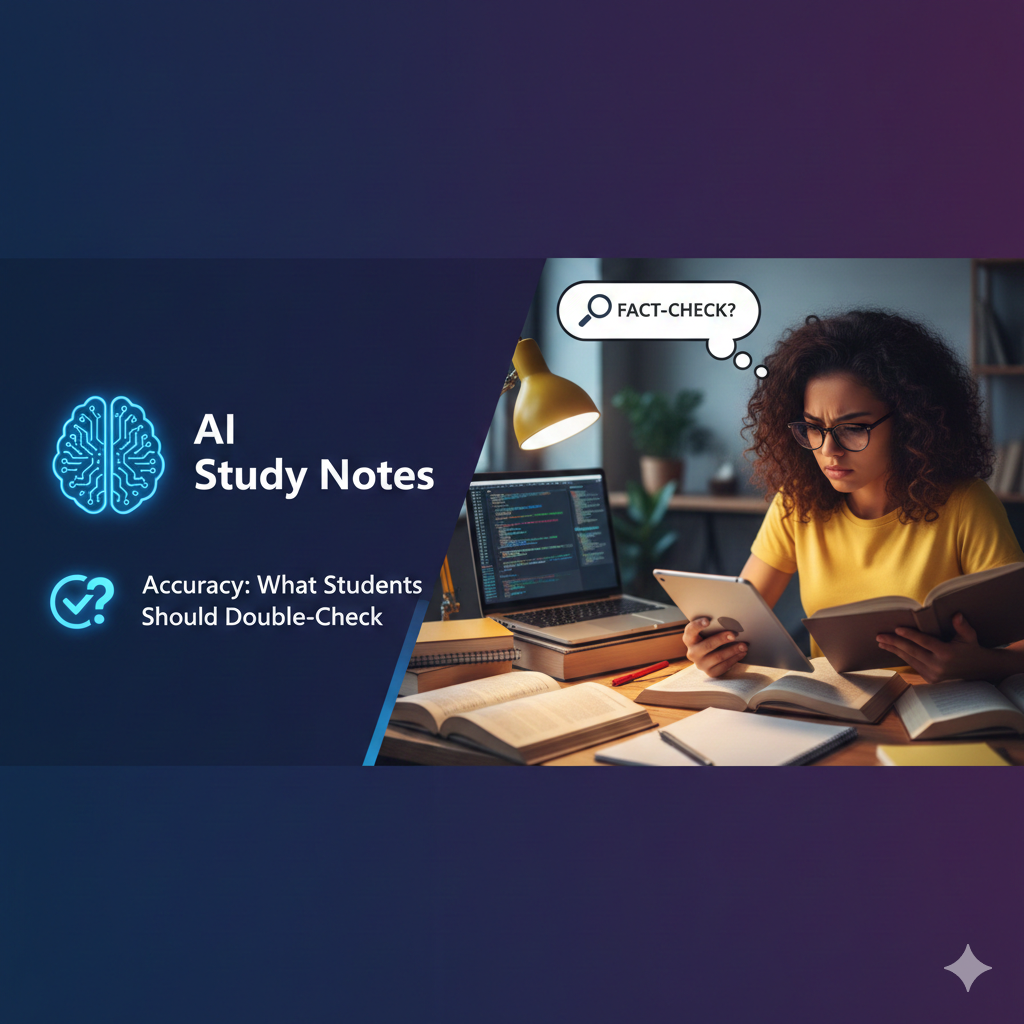
AI study notes accuracy is one of the biggest concerns for students using AI tools to summarize lectures, textbooks, and study material.
As AI tools summarize lectures, explain concepts, and organize coursework, errors often slip through unnoticed. These aren’t obvious mistakes; they’re subtle shifts in wording, missing conditions, or overconfident explanations. This article explains where AI study notes most commonly fail, what students should always verify before exams or submissions, and how to build a fast, repeatable accuracy-check system that protects grades without adding extra study time.
What “accuracy” really means in AI study notes
Accuracy in study notes isn’t just about correct facts. It includes:
Concept accuracy – Is the idea explained correctly?
Scope accuracy – Are limits and exceptions preserved?
Terminology accuracy – Are definitions aligned with the syllabus?
Application accuracy – Does it hold up in exam-style questions?
AI often gets the gist right while missing the edges that exams target.
Where AI study notes are usually reliable
From practical student use, AI notes tend to be accurate for:
1. High-level overviews
Broad explanations and topic summaries are usually correct.
2. Repeated or standard definitions
Common concepts taught consistently across sources fare well.
3. Structural organization
Headings, outlines, and topic grouping are strong.
These strengths make AI helpful for orientation and review.
Where AI study notes commonly go wrong

This is where students should be cautious.
1. Missing conditions and exceptions
AI often removes words like only if, unless, or in most cases—which matter in exams.
2. Overgeneralized explanations
Edge cases and special scenarios are frequently skipped.
3. Confident but shallow answers
AI explanations sound certain even when depth is missing.
4. Formula and unit mistakes
Small errors in symbols, units, or steps can cost marks.
Common student mistakes (and fixes)
Mistake 1: Trusting clean explanations
Fix: Ask, “Under what conditions does this fail?”
Mistake 2: Copying AI definitions into notes
Fix: Rewrite definitions in your own words and compare with the syllabus.
Mistake 3: Never testing AI notes
Fix: Apply them to practice questions immediately.
Information Gain — why AI errors are harder to detect than human errors
Most SERP articles focus on “accuracy rates.” What they miss is error detectability. Human notes show uncertainty—crossed-out lines, messy phrasing, question marks. AI notes look polished, which makes errors less visible. Counter-intuitive insight: the cleaner the AI note looks, the more actively it should be questioned.
Beginner mistake most students make with AI study notes
Assuming AI notes are “safer” than personal notes.
In reality, personal notes reflect your understanding—and your gaps. AI notes hide gaps behind smooth language. Students who treat AI notes as drafts and always create a short personal version catch far more errors.
A simple accuracy-check system students can reuse
This system takes 10–15 minutes per topic:
| Step | Action | Purpose |
| 1 | Read AI note once | Overview |
| 2 | Ask “when does this not apply?” | Find limits |
| 3 | Compare with syllabus | Alignment |
| 4 | Test with one question | Validation |
| 5 | Rewrite key points | Retention |
This catches most silent errors.
[Expert Warning]
Never submit AI-generated explanations or definitions without verifying them against official course materials.
[Pro-Tip]
Ask AI to list common mistakes students make for a topic. If your notes don’t address those, they’re incomplete.
[Money-Saving Recommendation]
Accuracy comes from process, not premium tools. Free AI plus disciplined checking beats paid tools without review.
(Natural transition) When choosing AI note-taking tools for studying, prioritize those that make editing easy and keep original sources visible.

Subjects where double-checking matters most
Be especially careful with AI notes in:
Mathematics and physics (formulas, units)
Law and policy (conditions, definitions)
Medicine and biology (exceptions, mechanisms)
Economics (assumptions, models)
These subjects punish small inaccuracies.
FAQs
Are AI study notes accurate?
They’re generally accurate at a high level but often miss conditions and edge cases.
What should students always double-check?
Definitions, formulas, exceptions, and exam-relevant details.
Do paid AI tools improve accuracy?
They may help slightly, but human verification matters far more.
Can AI notes replace textbooks or lectures?
No. They should supplement, not replace, official materials.
How often should I verify AI notes?
At least once per topic before exams or assignments.
internal link:
Embedded YouTube (contextual)
How to spot study mistakes: https://www.youtube.com/watch?v=IlU-zDU6aQ0
Active recall and error correction: https://www.youtube.com/watch?v=ukLnPbIffxE
external link:
Conclusion
AI study notes can save time—but accuracy still depends on you. The most damaging mistakes aren’t obvious errors; they’re missing limits, softened language, and overconfident explanations. When students double-check strategically and rewrite key ideas in their own words, AI becomes a reliable study partner instead of a silent risk.